A Good Neighbor – A Great Leader
For Linda LeMura, creating a sense of community is a guiding principle that has helped define her personal and professional life. She finds that community through her faith, her family, her profession and in working with other leaders and colleagues beyond the ÆÞÓÑÉçÇø campus.
Her 12-year tenure, which recently eclipsed that of William Reilly, S.J., as the longest-serving president in the history of ÆÞÓÑÉçÇø College, has been defined by steady leadership, remarkable success in a number of key areas, strategic collaborations and facing significant challenges head-on. Through it all, colleagues and friends say LeMura has never lost touch with her humble upbringing, her deep connection to the Central New York region and her fervent belief that students are at the epicenter of ÆÞÓÑÉçÇø’s Jesuit mission.
Linda is one of those rare leaders who combines intellectual rigor with deep emotional intelligence. She’s a serious scholar – and yet she leads with her heart as much as her head. She has enormous energy and an infectious enthusiasm that draws people to her and to ÆÞÓÑÉçÇø’s mission. But I think what sets her apart most is her genuine commitment to people. She doesn’t just talk about cura personalis – she lives it.â€�
“The attributes she possesses that make her such a successful, productive and, may I add loved, president are that she is positive, enthusiastic, smart, kind, compassionate and dedicated,� said Lucy Paris, who has been a personal friend for more than 30 years. “She is faithful to God, her family, friends, co-workers, students and to the world in general.�
These traits have been the hallmark of LeMura’s career and were evident long before she became ÆÞÓÑÉçÇø’s 14th president. She began her professional life as a professor of physiology and a prolific scholar publishing research in the field of pediatrics and obesity. In 2003, she joined ÆÞÓÑÉçÇø as dean of arts and sciences. Promoted in 2008 to provost and vice president for academic affairs, LeMura made history in 2014 when she became the first lay woman to become president of a Jesuit institution in the United States.
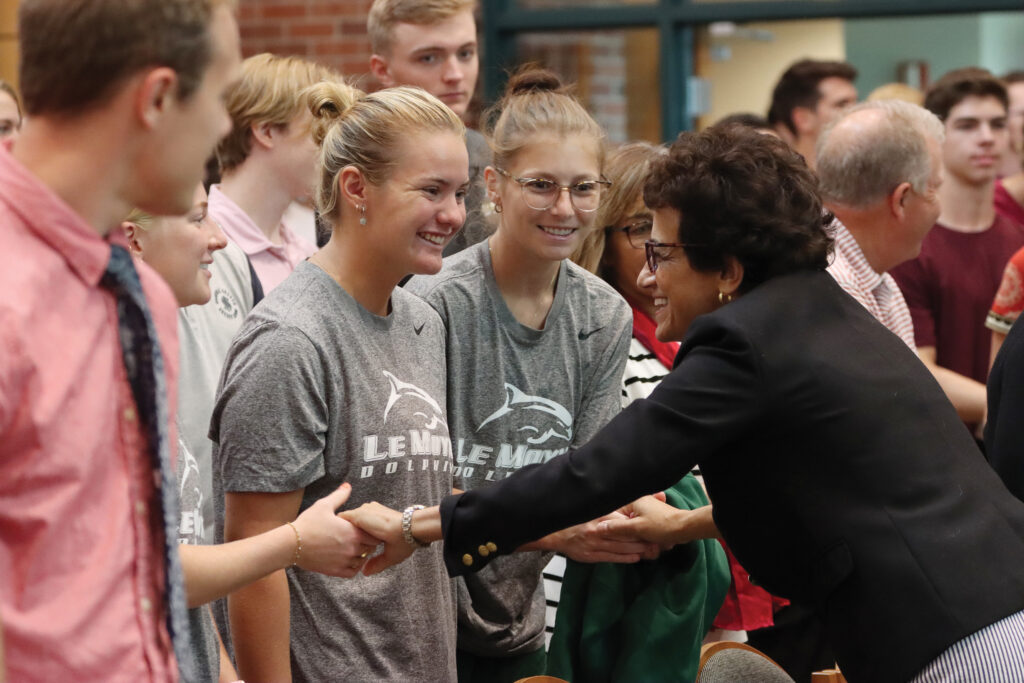
“We could see her passion and intelligence, and her love for the students,� said Sharon Kinsman Salmon ’78, who served as the chair of the board of trustees for that history-making promotion. “She admired and respected the faculty. She had developed several articulation and partnership agreements with other schools, and she was extremely knowledgeable about the challenges facing higher education.�
Her appointment started a trend that has literally changed the face of Jesuit education in the U.S., as 12 other institutions have since named female presidents, and earlier this year the Association for Jesuit Colleges and Universities (AJCU) named its first female president.
I am proud that I have helped pave the way for others. However, being a president has challenges and responsibilities no matter what gender you are.�
“Linda rarely, if ever, spoke of the pressures associated with being the first lay woman to lead a Jesuit college,â€� said Joe McShane, S.J., a ÆÞÓÑÉçÇø professor from 1982 to 1992 who went on to serve for five years as president of the University of Scranton before leading Fordham University from 2003 to 2022. “A practical visionary, she let her actions and plans speak for her. As a result, she quickly became a trusted (and revered) presence at the AJCU board table.â€�
Outside of the Jesuit network, her work in the Syracuse community illustrates her belief in the value of collaboration and partnerships. Ben Walsh, who served as mayor of Syracuse from 2018 to 2025, viewed LeMura as one of his key allies and confidante while he was in office.
“Having grown up in Syracuse and seeing neighborhoods go through tough times, as dedicated as she is to mission of ÆÞÓÑÉçÇø, she is equally passionate about getting the city back on solid footing,â€� said Walsh who, like LeMura, is a Syracuse native. “She recognized early on how we could best use the assets and economic influence of ÆÞÓÑÉçÇø to benefit the city as a whole and in particular the Salt Springs neighborhood that surrounds campus. She was always looking for opportunities to collaborate and recognizes that the College has a bigger role to play beyond the campus borders in terms of supporting the community.â€�
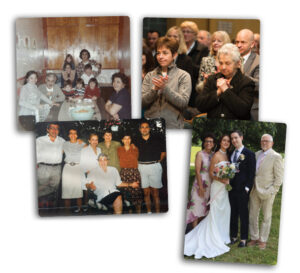 “Her commitment to the community flows naturally from who Linda is,â€� said Barlok. “She is a daughter of Syracuse – a first-generation college graduate, the child of Italian immigrants who arrived in the U.S. with no English and a pile of dreams. She has said it herself: ‘I am that kid’ – meaning she is the very student that ÆÞÓÑÉçÇø was founded to serve. For her, ÆÞÓÑÉçÇø’s relationship with Syracuse isn’t an institutional strategy. It is very personal – almost sacred … She sees the College and the community as inseparable.â€�
“She grew up here,â€� said Kinsman Salmon. “Integrating ÆÞÓÑÉçÇø with the whole community is positive for everyone involved. Inclusivity is in her nature.â€�
Prior to its closing in 2024, LeMura’s friend Paris worked in development for the Cathedral Academy at Pompei (CAP), a K to 6 school in Syracuse that is the president’s alma mater.
“Her involvement, integration and partnerships with the community, including CAP, is two-fold,� Paris reflected. “One is her passionate connections. She wants the best for what she holds dear. The other is looking for how best she can help foster and grow the community she lives in and loves. She is always looking to partnerships that realize the benefits of sharing resources, intelligence and ideas for the betterment of all.�
“Her question to me is always, ‘How can ÆÞÓÑÉçÇø help serve the diocese better,’â€� said Syracuse Bishop Douglas Lucia. “Through the work of Bishop Foery, the Syracuse Diocese was the catalyst for the founding of the College. The connection between the diocese and the College was there from the beginning.â€�
One development that promises to change the community is the pending arrival of Micron Technology’s semiconductor “megafab� facility, which broke ground in January 2026. Current plans call for a $100 billion investment over 20 years, with the first phase opening between 2030 and 2033. It is expected to create thousands of jobs.
LeMura has been a huge proponent of the project, recognizing how significantly it will transform the economic ecosystem of the entire region and all of upstate New York.
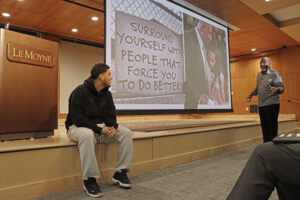 “In September of 2022, when most of you started high school, the Micron project hadn’t even been formally announced,â€� she said at a recent accepted student day event. “At that point it was an unknown – a possibility – a rumor. Yet here we are, four years later, and it is a distinct, concrete career option. I know that’s the case because we’re working closely with community leaders and Micron’s executives to ensure that this College and our students have a seat at the table for this historic opportunity. In fact, we’ve already had one student get an internship and then a full-time job with Micron, and they just broke ground a few weeks ago! That student was sitting in your seat not too long ago. And that student is now succeeding in a career he never expected. That’s what ÆÞÓÑÉçÇø has always done, and that’s what ÆÞÓÑÉçÇø will do for you.â€�
This exemplifies how LeMura views her role as president of the youngest of the 27 Jesuit institutions in the U.S. – with a mixture of enthusiasm, optimism and pragmatism, but always keeping the future of ÆÞÓÑÉçÇø and its students (and future alumni) at the forefront.
“In the course of the many conversations that we had during my summer visits to the Heights, I was struck by the fact that she was always restless, always looking for ways both to improve the College and to raise its regional and national profile,â€� said Father McShane. “I was also struck by the fact that she had the energy to take on the challenges connected with what she wanted for ÆÞÓÑÉçÇø. At the end of my visits, I was both energized and a bit exhausted.â€�
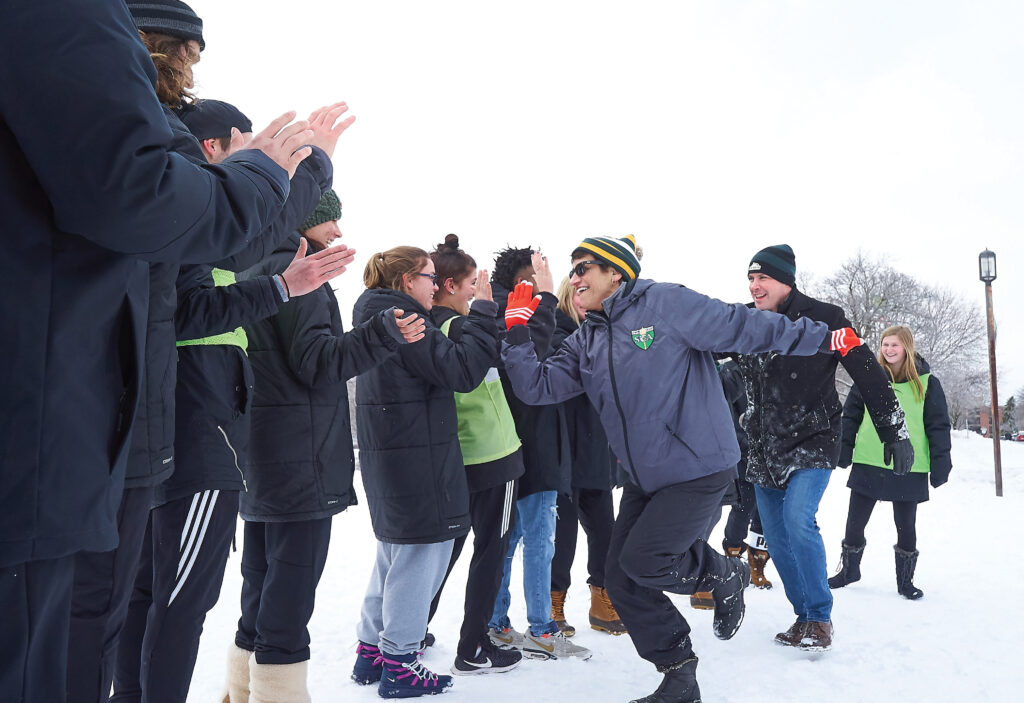
“She possesses a unique combination of positive attributes – exceptional intelligence, energy, passion and determination,� said Walsh. “Change is hard and when she sets her mind to something she will not lose focus until it’s done. That’s rare. A lot of people will start a project, but to have the energy and persistence to see it through makes her unique as a leader.�
Her skills and passion for leading others have positively impacted generations of students. Well into her second decade as president, she shows no signs of slowing down.
Higher education needs more leaders who can walk into a room, connect with a 19-year-old student and a 75-year-old donor with equal ease, crack a joke that lands perfectly, and then turn around and make a compelling case for why the institution deserves your support and your loyalty. Linda does all of that, and she makes it look effortless.�